

Understanding your vendor base is incredibly powerful.
Your vendor base is all approved vendors you can use to meet your business requirements. You may have contracts with them or they might be there, ready to be used as a risk mitigation play, to build resilience.
I have three relationships that I’ve continuously tracked in my vendor base - regardless of the role or industry I was operating in - to ensure I had visibility of what was happening here.
By tracking vendor relationships like this, you will build up a picture of risk and spend that you can use to improve elements such as:
This could elevate the way you work with vendors.
The first type of vendor relationship is vendors within the same company structure.
You can find information about company structure through the reports in Market IQ Finance, through your vendor onboarding process and within your contracts.
They may be in the same location but belong to a different trading entity.
They may be in various geographies, and you engage them in a localised strategy to manage your supply better.
You’ll have separate contracts with these companies, but you want to understand how they ladder up within their company structure.
This way, if one of these vendors underperforms but you’ve got another vendor in this company structure who is performing at the level expected, you can enquire as to why there is a difference in performance levels.
We’d also want to know if any entities were facing financial issues.
Or if one got hacked.
By using the vendor relationship feature in Gatekeeper, alongside Market IQ Finance and Cyber, you will be alerted should there be a drop in financial or cyber health through the mitigation workflow you have in Gatekeeper.
This could be an early indication of broader problems throughout the company structure. You can explore this further with the vendors.
The second type of vendor relationship is between resellers and the vendors who provide the software to you.
These relationships can get messy.
You might be wondering why you’d use a Reseller.
Some software vendors don’t want to deal with the commercial or contracting piece, so they work with resellers in specific regions.
This is also the same in manufacturing, components, computer boards etc. I’ve seen this setup across Defence, Aerospace, and FinTech.
You may use a handful of resellers, intermediaries between you and your software vendors. Or, you might have several software vendors with each of these resellers.
Not to mention from a contact perspective:
That’s a lot of contract paperwork.
And this can get out of hand fast if you don’t have robust contract review and signature processes in place that ensure you review agreements in light of the entire vendor relationship that you have.
And you’ll have to figure out the interconnection between the reseller agreement - what they’re responsible for - and how this ties in with the software vendor’s EULA.
So it’s vital to nail down the contract review element for these and to ensure you link not just the vendors but their contracts within Gatekeeper.
Beyond the contract complexities, you’ll be considering spend management.
It can be hard to track how much you spend with each Reseller and how much each software vendor costs.
You’ll want to stay on top of this. Especially as most reseller agreements will be multi-year, with cost increases and auto-renewals clauses that keep things rolling for multiple years if you miss the notice period.
The third type of vendor relationship is vendors working on the same programme or project. When dealing with Direct Procurement, you’ll want to have visibility of your vendors working on that programme.
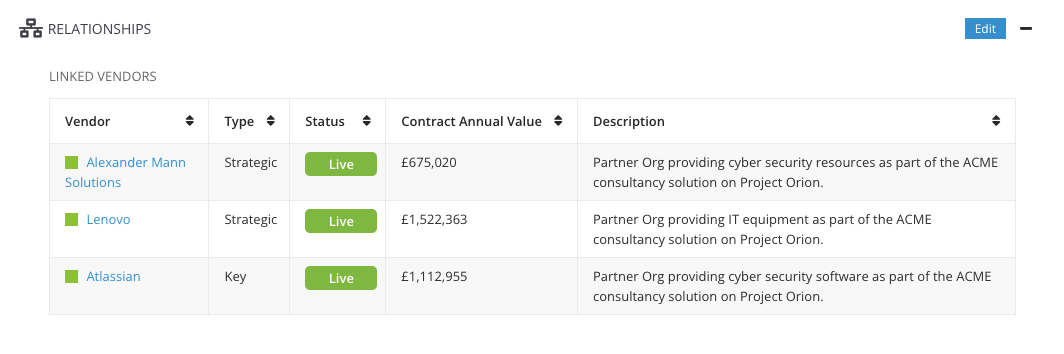
Software development consultants from three vendors may be coding part of your new product.
Not to mention the cloud host provider, your firewall, payments provider and external marketing agency. These are vital for a successful programme and go-to-market strategy.
You could link these vendors to show they are working on this programme.
If one underperforms, you can monitor the impacts across the entire programme.
This creates an easy way to track the spending accrued to date on the programme and the total contract value for the projected length of the programme.
In short, you’ve built a tier 1 supply chain map to help you understand how these vendors fit into your supply chain and identify any associated risks.
If you’ve set up your contracts with sub-contractor provisions, you can build a more complete nth-tier supply chain map as you are provided with more details.
You could export your vendor relationship data and build this out in Excel, Lucid or other visual design software.
Understanding your vendor base and tracking relationships to improve risk management, resilience, spend management, and leverage is critical for effective contract management.
Within Gatekeeper, you can track the following three types of vendor relationships:
By building a tier 1 supply chain map and identifying associated risks, companies can improve the way they work with vendors and overall supply chain management.
If you want to take your vendor management approach to a new level, let’s set up a meeting to discuss how Gatekeeper can help you with this.
Ready to improve your contract & vendor management?

Before Gatekeeper, our contracts
Anastasiia Sergeeva, Legal Operations Manager, BlaBlaCar
were everywhere and nowhere.
Gatekeeper is that friendly tap on the shoulder,
Donna Roccoforte, Paralegal, Hakkasan Group
to remind me what needs our attention.
Great System. Vetted over 25 other systems
Randall S. Wood, Associate Corporate Counsel, Cricut
and Gatekeeper rose to the top.
