
Non-profit organisations operate under the same commercial, regulatory and operational pressures as any mid-market business - often with tighter budgets, leaner teams and far less margin for error. While their purpose is driven by impact rather than profit, their operations are no less demanding than those of a commercial enterprise. In fact, in many ways, it’s more so.
For many non-profits, the question is no longer whether contract management software is useful, but how to implement it in a way that actually controls vendor risk, protects grant funding and stands up to audit scrutiny. The difference between basic digitisation and true operational control is where most organisations succeed - or struggle.
With income often reliant on an intricate blend of:
Non-profits must also navigate the unique legal frameworks tied to their tax-exempt status and charitable obligations. Managing this through manual contract workflows or disparate systems isn’t just inefficient - it’s a liability.
Traditional contract lifecycle management (CLM) platforms are increasingly being stretched beyond what they were designed to do. While CLM can help non-profits store agreements and manage signatures, it treats contracts as isolated documents.
In practice, contracts are inseparable from the third-party relationships they govern - vendors, partners and grantees that introduce ongoing risk, funding obligations and compliance requirements long after signature.
Rather than managing grant agreements, service providers, funded partners and compliance requirements in disconnected systems, mature non-profits operate from a single, unified model.
Intake decisions - such as grant conditions, risk checks and reporting schedules - carry through contracting and into day-to-day oversight, giving teams continuous visibility across the full third-party lifecycle and reducing the governance gaps that put funding and credibility at risk.
At its core, this is about non-profit contract management - specifically how organizations manage contracts, vendors and third parties in a compliant, auditable way.
Every contract within a non-profit is more than a legal formality - it’s a vehicle for impact. Whether it’s a grant agreement, a vendor service contract, or a partnership Memorandum of Understanding, each carries compliance risks, financial obligations, and mission-critical deliverables. Failure to manage these elements effectively risks:
Gatekeeper eliminates these blind spots by unifying non-profit contract management, third-party risk management and vendor oversight into a single, AI-powered workspace. This integration is particularly valuable for non-profits, where siloed departments, overstretched staff, and paper-based processes are still the norm.
Most non-profits are doing a lot right. As programs grow and funding increases, contracts, grants, vendors, and spending naturally spread across emails, spreadsheets, and different systems - while expectations from funders, regulators, and boards continue to rise.
High-performing non-profits address this by bringing structure and consistency to how third-party relationships, contracts, and obligations are managed across the organization.
Non-profits often need to move quickly, onboarding vendors, delivery partners, or grantees under real-time pressure. When due diligence happens late or inconsistently, risk shows up in audits, compliance reviews, or data exposure.
More mature organizations address risk early. Vendors and partners are reviewed before contracts are signed, expectations are clearly set up front, and approval decisions are documented, so issues are prevented rather than discovered after the fact.
Grant agreements, service contracts, and partnership arrangements all come with different rules, approvals, and compliance requirements. When these are handled manually, teams slow down or bypass process entirely.
Organizations that scale effectively standardize how contracts are created, reviewed, and approved. Clear guardrails allow teams to move faster without cutting corners, reducing last-minute reviews and contracts signed outside policy.
Late or incomplete reporting creates stress while putting funding and credibility at risk. When reporting requirements live in inboxes or individual calendars, deadlines are easy to miss.
More disciplined teams centralize grant obligations and reporting schedules, assign ownership, and track progress continuously. Reporting becomes predictable and controlled, not a scramble every quarter.
With limited budgets, even small inefficiencies add up. Duplicate vendors, silent renewals, and spend that drifts away from contract terms quietly erode funding over time.
Non-profits with stronger controls maintain visibility into vendor relationships, contract terms, and actual spend - so they can spot waste early, address underperformance, and keep funding aligned to mission priorities.
This isn’t about digitizing paperwork. It’s about giving non-profits the clarity, confidence, and operational discipline needed to grow responsibly - without increasing risk or administrative burden.
As non-profits scale, the administrative work behind grants, contracts, and third-party oversight grows quickly, often without the headcount to support it. Gatekeeper addresses this by embedding agentic AI directly into its contract and third-party management platform.
LuminIQ is Gatekeeper’s AI capability. It’s not a separate tool or add-on. It’s how Gatekeeper handles the manual, repetitive work that typically slows down grants, finance, and operations teams.
For non-profits, this is especially valuable in grant management, where critical requirements - reporting schedules, spending limits, approval conditions - are often buried in PDFs and enforced long after a grant is awarded.
Instead of relying on people to remember what’s in each document, Gatekeeper uses LuminIQ to turn those requirements into structured data that stays active throughout the life of the grant.
This allows teams to manage grants, vendors, and third-party obligations consistently, without adding staff or building fragile manual processes.
Differentiate grant documents correctly
Treat grant applications, grant agreements, and grant awards as distinct contract types, each with their own rules, rather than lumping them together as generic contracts.
Capture reporting requirements upfront
Extract and track reporting frequency and reporting due dates directly from grant documents, ensuring deadlines are visible and acted on well before they’re missed.
Manage the full grant lifecycle
Route grants through the right approvals, maintain visibility into grant conditions over time, and ensure obligations don’t disappear after signature.
Track allowable spend against grant rules
Monitor how much can be spent, where it can be spent (including categorical restrictions), and ensure spending aligns with donor or funding agency requirements.
Connect grants to vendors and payments
Link grant funding directly to vendors, service providers, and third-party spend - so payments are always traceable back to the source of funding.
Support one-off and edge-case agreements
Create simple, templated agreements for one-off speakers or event contributors, while still tying that spend back to the correct grant.
Proactively manage obligations and deadlines
Use automated reminders and workflows to stay ahead of reporting requirements and other grant obligations, rather than reacting at the last minute.
Teams know what they’re allowed to spend, where obligations sit, and how vendors and payments connect back to funding, all without adding headcount or building fragile manual processes.
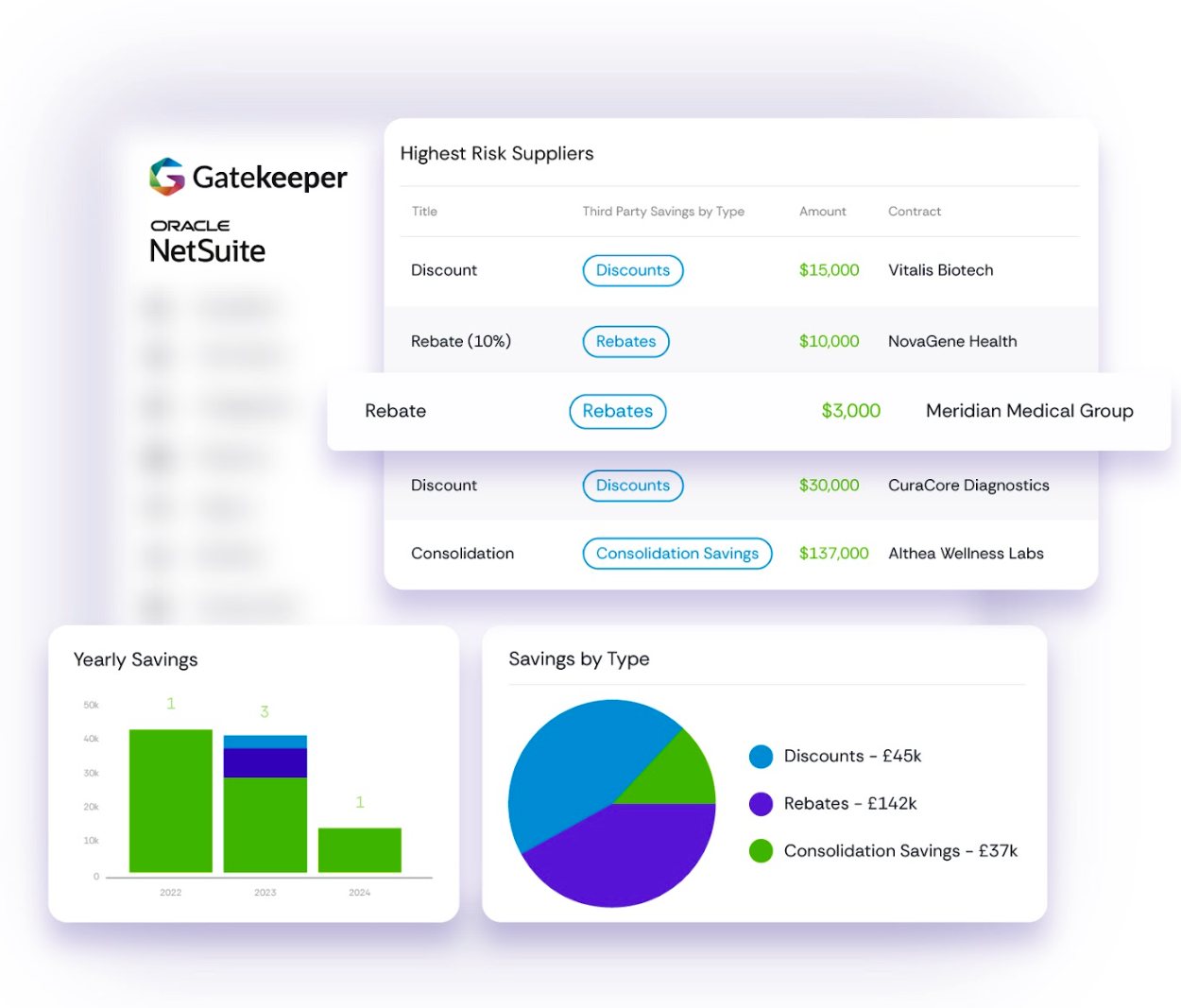
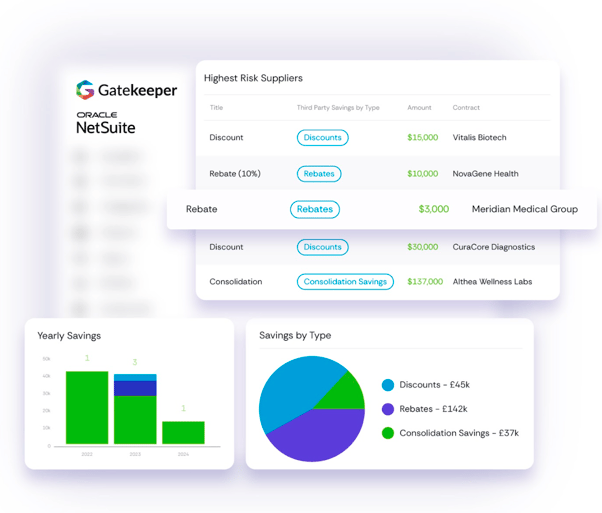
For finance-led non-profits using NetSuite, Gatekeeper becomes a natural extension of how financial control already works. Rather than adding another system for teams to manage, Gatekeeper integrates directly into NetSuite so finance, procurement, and compliance teams can work from the same data without duplication or manual reconciliation.
As a Built-for-NetSuite - certified solution and Oracle NetSuite’s 2024 International Partner of the Year, Gatekeeper is designed to fit into existing finance workflows. Vendor records, approvals, contracts, and spend data remain connected, reducing the handoffs and blind spots that often appear when contract and third-party management live outside the ERP.
In practice, this gives non-profits stronger control where it matters most:
Risk and compliance checks flow directly into NetSuite vendor records, so finance teams can clearly see which vendors are approved, which are pending review, and which carry elevated risk—without relying on spreadsheets or separate systems.
Contract terms, obligations, and risk context sit alongside financial data, making it easier to understand reporting requirements, spending limits, and renewal conditions before payments are issued.
Actual spend can be compared against contract expectations in real time, helping teams identify overspend, unused commitments, duplicate vendors, and silent auto-renewals before funding is lost.
Audit and reporting processes become simpler, since approvals, contracts, vendor due diligence, and spend history are already linked and accessible from a single financial system of record.
The result is stronger financial governance without slowing the organization down.
Finance teams gain confidence that spending aligns with grant conditions and board expectations, leadership gets clearer visibility into obligations and risk, and reporting cycles become faster and more predictable. Instead of managing contracts and vendors around NetSuite, non-profits can manage them through it - protecting funding while reducing manual work.
What separates high-performing non-profits from those constantly reacting to audits, funding issues and operational fire-drills isn’t intent or mission clarity - it’s control across the entire third-party lifecycle.
Gatekeeper is built around a simple but non-negotiable principle: risk, contracts and vendors must be managed as one continuous process, not disconnected events.
That lifecycle looks like this:
Every vendor, delivery partner or funded third party enters through a single intake process. Due diligence, financial health, cyber posture and compliance checks happen before access, funding or data is granted. No shortcuts. No retrospective clean-up.
Approved third parties move directly into governed contracting. Grant agreements, service contracts and partnership terms are created or reviewed within guardrails that reflect funding rules, regulatory obligations and internal policy - so speed never compromises compliance.
Once signed, contracts don’t disappear into shared drives. Reporting deadlines, evidence requirements, SLAs and renewal conditions are extracted, assigned and actively monitored against the third-party record.
Vendor risk profiles, performance and spend are continuously reviewed. Renewal decisions are proactive, not reactive. Underperforming suppliers are surfaced early. Duplicate vendors and silent auto-renewals are exposed before funding is wasted.
This closed-loop model is how Gatekeeper turns contract and third-party management from an administrative burden into a source of confidence, control and funding protection.
Non-profits operate in an environment where trust is currency. Funders, regulators and boards increasingly expect the same level of third-party governance as regulated commercial organisations - without providing the same resources to achieve it.
The consequences of weak third-party and contract control are real:
Gatekeeper is designed to remove these risks before they surface externally. By maintaining a single source of truth for every third party, every contract and every obligation, non-profits can demonstrate due diligence, compliance and financial stewardship on demand - not weeks later, after a scramble.
If your organisation needs to reduce third-party risk, strengthen audit readiness and ensure funding is protected at every stage, Gatekeeper provides the structure, visibility and discipline to do exactly that.
Book a demo today and see how modern third-party and contract management supports sustainable, mission-led growth.
See how to manage grants, vendors, and contracts with a unified approach.

Before Gatekeeper, our contracts
Anastasiia Sergeeva, Legal Operations Manager, BlaBlaCar
were everywhere and nowhere.
Gatekeeper is that friendly tap on the shoulder,
Donna Roccoforte, Paralegal, Hakkasan Group
to remind me what needs our attention.
Great System. Vetted over 25 other systems
Randall S. Wood, Associate Corporate Counsel, Cricut
and Gatekeeper rose to the top.
