






.png)
What is contract intelligence?
Contract intelligence describes AI that reads contract documents and produces structured, queryable data. It does three things: it extracts information from the document, makes that information comparable across a portfolio, and acts on what it finds. Extraction and classification cover the first two. The third is where products diverge most.
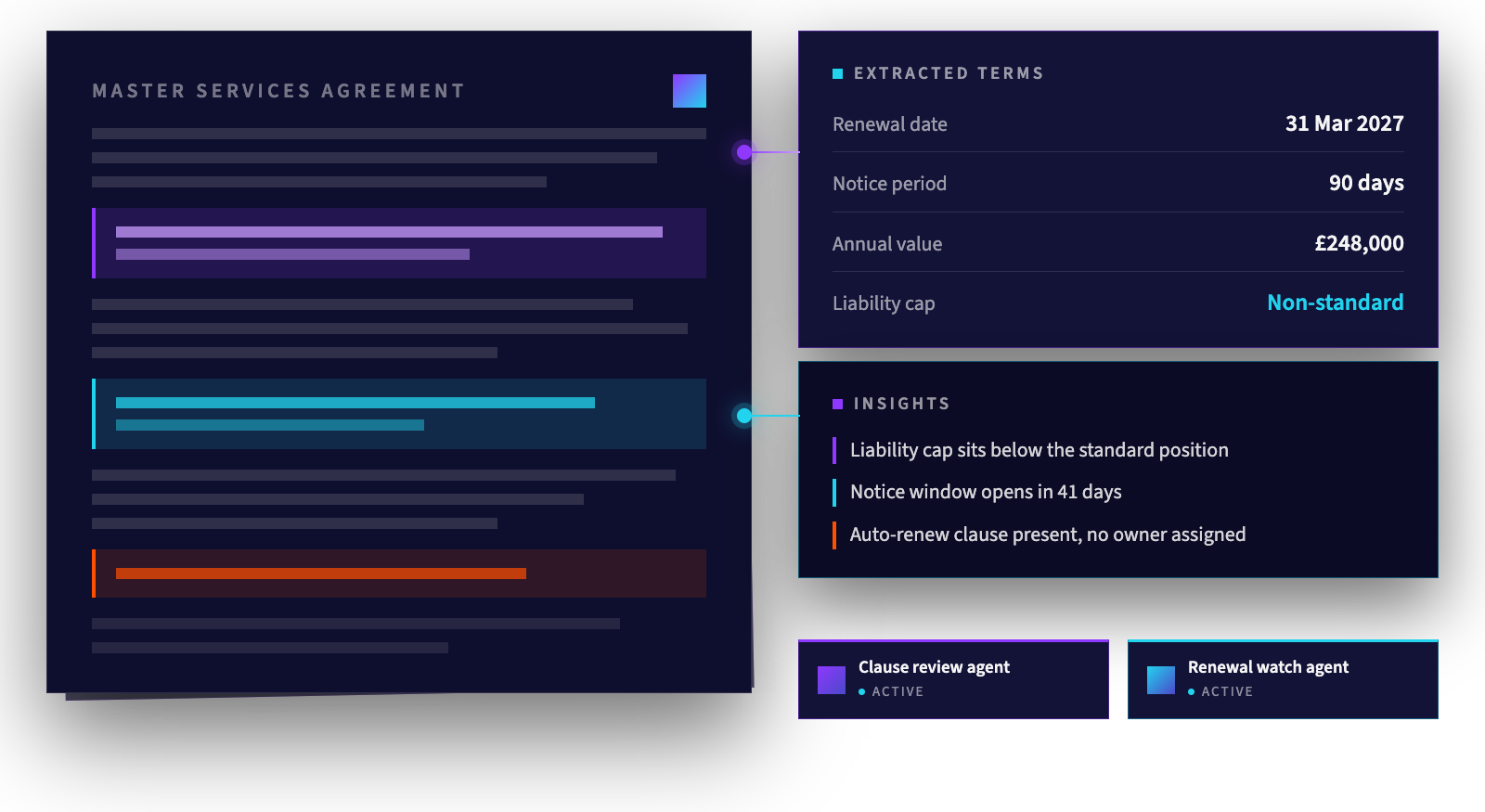
To a file system, a signed master services agreement is a name and a date. Contract intelligence reads it and returns a record: counterparty, annual value, notice period, liability cap, renewal mechanics. Those become fields, and fields can be filtered, compared and monitored.
Until recently, the definition was structured data plus workflows plus reporting, which described a system that told you things. Reporting waits for a person to notice, and a dashboard showing 14 renewals inside their notice window is only as useful as the diary of whoever opens it. The current definition is more demanding: it reads your contracts, decides what to do within limits you set, and routes the exceptions to a person.
How is contract intelligence different from a repository, contract analytics and contract lifecycle management?
Four things get called the same thing and sit at different depths, and the distinction matters because all four are routinely sold under the same label.
- A repository stores contracts.
- Search finds them.
- Contract analytics reports on the data inside them once it has been extracted.
- Contract intelligence reads them and then acts within configured limits.
Here is the part almost no page on this topic mentions: the analysts do not use the term. Gartner's market for this technology is called Advanced Contract Analytics, and the capability it treats as mandatory is “Contract visibility/data extraction: Extract and classify contract data to provide better visibility and reporting on contract metadata, and terms and conditions.” So comparing products by category label tells you close to nothing, and the comparison has to happen at the level of specific behaviour.
"Every vendor is an 'AI-native CLM.' Every vendor claims to be 'contract intelligence.'"
A contract lifecycle management system is also not an alternative. It moves a contract to signature, where contract intelligence reads what got signed and keeps working afterwards. That is why a contract can execute efficiently and then go quiet while the relationship it governs carries on changing. More in our guide to why a contract system on its own is not enough, and the capability sits in Gatekeeper's contract lifecycle management, on one unified vendor and contract record.
How does contract intelligence actually work?
Extraction, enrichment and insights are three separate capabilities, not one fixed sequence. Extraction turns a new document into a record as it arrives. Enrichment is a separate, retrospective job that fills gaps in existing records. The one real dependency is between extraction and insights: a summary or obligations list is generated from the master record, so that record has to be populated before it can be summarised.
Extraction
Extraction creates a contract record from a document. It does not just file the document under a record. An uploaded agreement returns a populated record covering contract name, vendor, currency, annual value, type, category, entity and dates, plus any custom fields configured for extraction, with the file attached as the master record. The middle stage is the one that matters: at review, extracted metadata sits beside a preview of the document, and every field can be edited before it is confirmed. The same works at the front of the process, where a document uploaded to a contract request, submitted through a portal form, or emailed to a designated address populates the workflow card directly. See AI-powered contract data extraction.
Enrichment
Enrichment is a separate job for the backlog every organisation has: legacy records with a document attached and half the fields empty. It reads the master record on contracts that already exist and populates the blanks. The guardrail is scope: it fills empty fields only, and never overwrites existing values.
Insights
Insights produces two things from the master record: a plain-language summary of the agreement, and an obligations list covering deliverables, payment terms, renewal actions and notice periods, prioritised with red, amber, yellow and green coding and split into what you owe and what the counterparty owes. Where it appears matters as much as what it says. The summary appears on the contract record, in e-signature emails to internal signatories, and on negotiation workflow cards, so an executive asked to sign sees it in the email rather than opening a 13-page document.
One prerequisite decides whether any of this helps. World Commerce & Contracting reports contract data sitting across an average of 24 different systems, “making it nearly impossible to track commitments or optimise decisions on a timely basis”. Because summaries and obligations are generated from a master record, one authoritative version of each agreement has to be identified before anything is produced.
What can contract intelligence do once your contracts are readable?
Reading a contract is the input. The output is work that happens without a person starting it. Gatekeeper organises this into AI agents working in teams, and the contract lifecycle team covers the whole arc: triage on arrival, first-pass review, amendments, obligations after signature, and the renewal decision. Each agent does one job and hands on to the next.
Before review, triage
The Contract Intake Agent identifies, prioritises and routes incoming contracts for faster review, and the Contract Categorisation Agent classifies incoming contracts by type and applies consistent categorisation.
Triage may sound like the least interesting part, but it removes the most waste. The agent identifies the contract, checks it against intake eligibility rules, applies priority indicators, and determines the right workflow based on contract type, value, and intake attributes. Contracts that fail pre-screening are flagged for follow-up according to rules you configure, so nothing sits in an inbox waiting to be noticed.
At review, the first pass
Two agents work here. The Contract Review Agent surfaces non-standard contract terms and summarises key clauses by comparing what arrived against your legal playbook. It identifies where language differs from your standard terms and explains how it diverges, flags required provisions that are absent altogether, such as data protection, audit rights or force majeure, and pulls out value, term length, renewal mechanics and key obligations. Different rules apply to NDAs, MSAs and SOWs, and you configure which deviations are acceptable and which need a person. The stated outcome describes a change in the work, not a saving in minutes: “Legal capacity shifts from reading to judgement.”
The Contract Clause Review Agent does something narrower and more predictable. It locates and extracts a fixed set of ten clauses from every contract and adds structured summaries to the record: indemnity, limitation of liability, termination for convenience, force majeure, data protection, intellectual property, confidentiality, insurance, governing law and jurisdiction, and term and renewal. Custom clauses can be added beyond those ten. Predictability is the feature here, because every contract gets the same treatment, whoever uploaded it, and that is what makes a portfolio comparable. See clause-level summaries.
At change, the amendment
Amendments are where quiet erosion happens, because a small change to a live agreement rarely gets the scrutiny the original did. The Contract Amendment Agent reviews them across four dimensions: completeness, redline mapping, commercial terms and legal compliance. Redline mapping “traces all changes to specific clause IDs, confirms nothing is hidden in deletions”. Commercial terms are compared against your authority thresholds. And the compliance check “blocks amendments that remove mandatory clauses like liability caps, indemnification, IP protection, or data handling obligations”.
After signature, the obligations
The Contract Obligation Extraction Agent covers six categories, and the specificity is the useful part.
- Payment obligations: amounts, due dates, frequency and any attached conditions.
- Performance deadlines: delivery and installation dates, support response times, service level commitments.
- Renewal and termination dates: the initial term end, auto-renewal mechanics, the notice period for non-renewal, and termination options with their deadlines.
- Reporting and compliance obligations: regular reporting, audit rights and certifications.
- Insurance and coverage milestones.
- Data handling obligations: processing terms, breach notification timelines, retention schedules, security certification deadlines.
Read that list against how obligations are usually tracked: a spreadsheet built by hand from whichever contracts someone had time to read. More on extracting obligations from a signed contract.
At renewal, the brief
The Contract Renewal Agent generates structured renewal briefs with performance assessments, working across four dimensions: the contract's foundation data, the key commercial terms, how the counterparty has performed against service levels, and a risk and opportunity assessment, with your stated negotiation priorities as a configured input. Thresholds can be set so high-value contracts get senior review instead of the standard process.
Redwood Logistics manages around 1,200 vendors and over $90m in contracts, and runs roughly 300 renewals a year, each of which previously took up to an hour of preparation. Automating that preparation returned hundreds of hours to the procurement team. At CompSource Mutual, the change was in what leaders read: 10-line AI summaries in place of 13-page contracts, cutting executive review time per contract by around 95% and freeing about 636 hours a year. Both are Gatekeeper customer figures, not independent research, and we label them as such.
How do you keep control when agents are deciding on your contracts?
Control comes from three configured things: what the agent may decide, what it measures against, and what it leaves behind. Autonomy is a setting rather than a property of the technology, and you should set it narrowly at first. All three are visible in the product, so you're not just trusting the vendor's word.
Every agent runs in one of three modes:
- Approve or reject: the agent makes the decision.
- Review: the agent produces a recommendation, and a person makes the decision.
- Update a form: the agent fills in data and decides nothing.
Placement is separately configurable: as a parallel approver in the same phase, or in a separate phase before or after. Being straight about the top of that range matters, because plenty of vendors are not configured to do so; an approval agent can decide with no human input. That suits a high-volume, low-risk lane and makes a poor first deployment on commercial contracts.
What it measures against is your material, not a general model of good practice, and the guardrail is stated plainly:
"The agent operates only within the permissions you configure in your playbooks and authority matrices."
What it leaves behind is an account of how it reached its decision, held in the card history. A decision you cannot reconstruct is a decision you cannot defend, which is why that record often settles it for a legal team.
How accurate is contract intelligence, and how do you check?
Purpose-built legal AI still gets things wrong at a rate that should shape how you deploy it, which makes accuracy claims the weakest thing to buy on and authority limits the strongest. The published evidence is uncomfortable for the whole category, including the parts of it that market themselves as solved.
Researchers at Stanford's RegLab tested three commercial legal AI research tools against more than 200 preregistered queries and published the results in the Journal of Empirical Legal Studies. Hallucination rates ran from 17% to 33% depending on the tool, and the authors concluded that providers' claims about eliminating hallucination through retrieval were overstated. That study tested legal research tools, not contract extraction, so it does not directly measure contract intelligence products. It measures something more useful: whether pointing a model at a trusted corpus removes error. It does not. On contracts specifically, a 2025 preprint benchmarking 19 models for clause-level risk identification against expert-annotated agreements found most performing at roughly the level of a junior legal assistant.
Four questions cut through most of it, and none is about an accuracy percentage:
- Can it show you the source text behind every extracted value, on demand?
- Whose playbook is it reviewing against, and who can change it?
- What is each agent allowed to decide without a person, and where is that configured?
- What happens when it is uncertain: does it leave the field empty, escalate, or guess?
What does weak contract intelligence cost?
The most quoted number in this field needs care. World Commerce & Contracting's core measurement is value erosion against expected contract value, and the current figure is 8.6%, not the roughly 9%-of-annual-revenue figure that circulates most widely, including in WorldCC's own August 2025 report, where both framings appear.
The wording of the primary measure is worth having exactly:
"The average value erosion (the deviation from expected results) is 8.6%."
Restating that figure as a share of company revenue instead of expected contract value inflates it by an unknowable margin, and the estimate underneath both versions carries a further caveat: WorldCC's original 2014 research acknowledged the number as an estimate that could not be scientifically validated. The smaller, better-documented denominator is the one worth citing.
Where the erosion comes from is easier to see than to measure. EY, in 2021 research with Harvard Law School's Centre on the Legal Profession covering 1,000 contracting professionals, found that 71% of respondents said they lacked the technology to monitor contracts for deviations from standard terms, and that 90% had difficulty locating contracts at all. The cost then falls differently on each team. Legal's exposure comes from being buried rather than from carelessness. Procurement, measured on cycle time and savings, is blocked by a review queue someone else owns. And for finance, a renewal nobody can see is a budget variance waiting to happen. See what contract data does to forecast accuracy.
Renewals deserve a candid note. No industry body, analyst or academic source has measured the cost of missed renewals and unwanted auto-renewals; every figure in circulation traces to a software vendor's own marketing or to a statistics aggregator with no primary source, which is why none appears here. What we can offer is our own customer data, labelled as ours: one Gatekeeper customer avoided over $1.3m in unwanted renewals. A single missed notice period on a three-year agreement is its own business case, and an unmanaged contract is where that starts.
The gap between those teams is where most exposure sits. A risk finding that never becomes a clause, a condition or a tracked obligation has cost the effort of the assessment and prevented nothing. Closing that gap needs the contract, the vendor, the risk and the spend on one unified record, which is what Gatekeeper unifies across contracts, vendors and spend is built to do.
Where should you start?
Start narrow, on one contract type, with the agent set to recommend rather than decide. Take the baseline first, because you cannot recreate it later: how long a review takes today from arrival to sign-off, how many obligations are currently tracked, and how many renewals last year went through without a negotiation.
Then pick the lane where volume is high and a wrong call is cheap, usually NDAs and standard renewals, and widen once that lane has shown you where the agent's judgement matches yours. You will not be early to this: Deloitte's 2025 survey of more than 250 chief procurement officers across 40 countries found contract summaries and key-term extraction already the third most common use of generative AI in procurement, at 41%.
Frequently asked questions
Is contract intelligence the same as contract lifecycle management?
No. Contract lifecycle management moves an agreement through drafting, negotiation, approval and signature. Contract intelligence reads what was signed and acts on it across obligations, renewals and risk. The two work together, and neither replaces the other, and most organisations with the first have very little of the second.
What is the difference between contract intelligence and contract analytics?
Contract analytics reports on contract data once it exists, which usually means once someone has extracted or keyed it in. Contract intelligence covers the extraction itself and acting on the result within configured limits. Gartner's market category for this technology is Advanced Contract Analytics, so the two terms overlap heavily in practice.
Will contract intelligence replace legal or procurement teams?
No. It changes what the work consists of. First-pass review, clause extraction and obligation tracking move to agents, while negotiation, judgement on a genuine deviation and the commercial decision stay with people. The effect is a shift in what the team spends its hours on, not a reduction in headcount.
How does contract intelligence handle legacy or poorly scanned contracts?
Legacy records are handled as a separate batched job that reads the attached document and fills empty fields. New contracts follow a different route. Scanned documents depend on OCR quality; it reads Latin-alphabet languages, not Cyrillic, and summarisation has an 80,000-word ceiling. A portfolio audit before the first run is worth the time.
Is contract intelligence only for legal teams?
No, and treating it as a legal tool is a common way to under-use it. Procurement gains most from faster first-pass review and renewal preparation, finance from renewal dates surfaced before the invoice arrives, and risk from findings that carry through into contract terms. The data one team generates is what makes it useful to the next.
