



Skip to content
Back

New research from the Hackett Group.

Standalone CLM is becoming a compliance risk.

Watch the Full Analysis of the Findings

New White Paper

Standalone CLM is becoming a compliance risk.

  • Procurement workload rises 8% in 2026, while both headcount and budget fall (The Hackett Group, 2026 Procurement Agenda and Key Issues Study)
  • One person managing 300+ suppliers is now a reality in some mid-market teams
  • DORA, NIS2 and the CSDDD demand active, ongoing due diligence on every supplier, not a single check at onboarding
  • AI-enabled technology has entered procurement's top three priorities for the first time

    Standalone CLM cannot close that gap, because it sees the contract but not the supplier risk behind it. The Hackett Group's new white paper makes the case for running contract management and third-party risk on one data model, where risk shapes the contract, obligations are monitored after signature, and AI agents work across the whole lifecycle rather than a fragment of it. 

    Read the research to see what that looks like in practice.
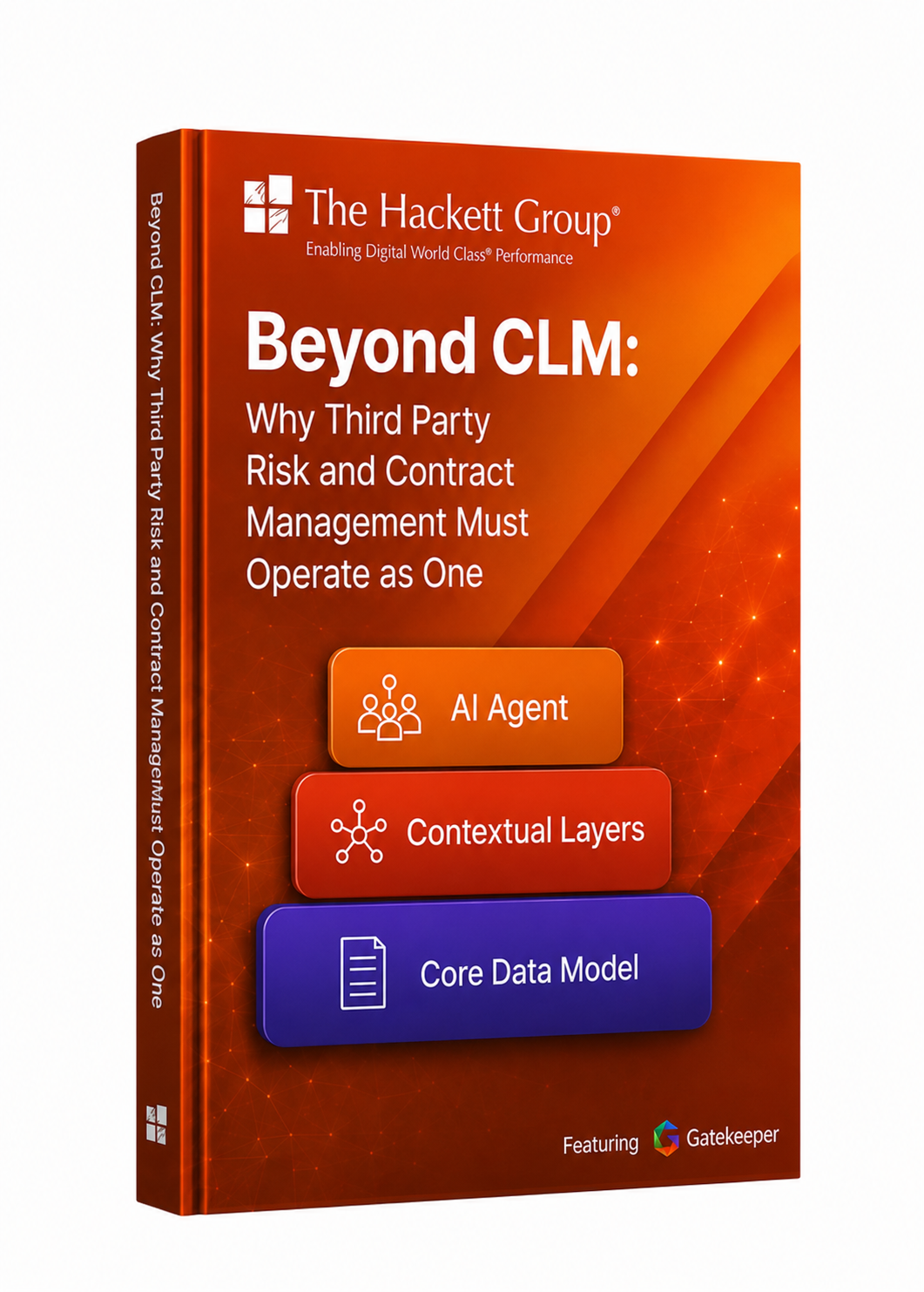

Hackett Group White Paper Beyond CLM

Common questions asked by new customers

What is "Beyond CLM"?

Beyond CLM is the argument, set out in new research from The Hackett Group with Gatekeeper, that contract lifecycle management can no longer stand alone.

It holds that contract management and third-party risk must operate as one connected process, so that compliance, monitoring and AI agents can work across the full lifecycle rather than a fragment of it.

What is the difference between CLM and TPRM?

CLM covers the creation, negotiation, execution and renewal of agreements. TPRM covers screening, assessing and continuously monitoring the suppliers behind those agreements. They answer different questions: CLM asks what was agreed, TPRM asks whether the supplier can be trusted to deliver it. Run in separate systems, the two lose sight of each other.

Why isn't standalone CLM enough for compliance and risk today?

Standalone CLM manages documents well but has no native view of supplier risk. Contracts get signed before suppliers are properly assessed, obligations sit unread in PDFs after signature, and renewals arrive with no record of how the supplier actually performed. The Hackett Group's analysis argues this gap is structural, not a configuration problem.

What's wrong with bolting CLM onto an S2P (source-to-pay) suite?

An S2P suite treats a contract as one step in a buying process, not as a lifecycle to be managed and monitored after signature.Spend Matters research finds that CLM added to an S2P suite still cannot connect contract obligations to live third-party risk, so the same blind spots reappear.

What does it mean for contract management and third-party risk to operate as one?

It means contracts and supplier risk share a single data model, so risk assessment informs contract terms, signed obligations feed ongoing monitoring, and supplier performance shapes renewal decisions.

Instead of two systems swapping exports, one continuous record covers intake through renewal. This is the shift The Hackett Group describes as moving beyond CLM.

Why do AI agents fall flat without a unified data model?

AI agents can only reason over the data they can see. When contracts live in one system and supplier risk in another, an agent works from a fragment of the picture and produces fragmentary results. A unified data model gives agents full lifecycle context, which is what turns them from a feature into reliable, end-to-end help.

What do Digital World Class organisations do differently with contracts and third-party risk?

Digital World Class organisations, as defined by The Hackett Group, treat contract management and third-party risk management as one connected process rather than two parallel systems. They standardise on a shared data model, automate the routine execution work, and keep due diligence continuous, which is what lets them stay compliant without adding headcount.

What does poor integration between contracts and supplier risk actually cost?

The costs show up in three places: vendor spend lost to auto-renewals, overlapping suppliers and unused services; hundreds of hours per audit cycle spent locating contracts and assembling compliance evidence; and exposure to fines under regulations such as DORA, NIS2 and the CSDDD. For lean teams, the manual workload alone is unsustainable.