







Procurement teams
How to tell your manager what you inherited without it sounding like an excuse.
You're weeks into a job where buying has been happening without you, renewals have been arriving unannounced, and nobody can produce a list of who the business pays.
Your manager has asked how it's going.

Inherited mess
You should consider separating two things
before you speak to your manager
FIRST
What was happening when you arrived
No ownership across suppliers, missed renewals, nothing well documented. Stated as fact, with no one's name attached.
SECOND
What the dates are against everything
Lead with whatever has a deadline and a hefty renewal cost or terms to renegotiate. Keep the volume of the mess out of your opening line.
Why does it feel worse than it is?
You're holding the whole picture and assuming nobody has seen it. In reality, other people have seen the issues at the step in the process they encounter most.
The person who raises their own PO knows; the person who signed something without telling you knows; and finance has seen at least one invoice arrive without a PO.
What none of them has is the aggregate, the pattern, or the number, and this is what you're bringing. It's new information, and useful information. It's not bad news, even if it feels that way to you.
Don't tell your manager you've 'found a problem' because it invites a bad reaction. Nobody wants to hear the word 'problem'. For many, it's counterproductive and stress-inducing. Instead, lead with, 'I've put together the first picture of what we're committed to, and here's what it shows', as it invites a positive reaction to your hard work and proactivity.
How do you separate what you've inherited from what you now own?
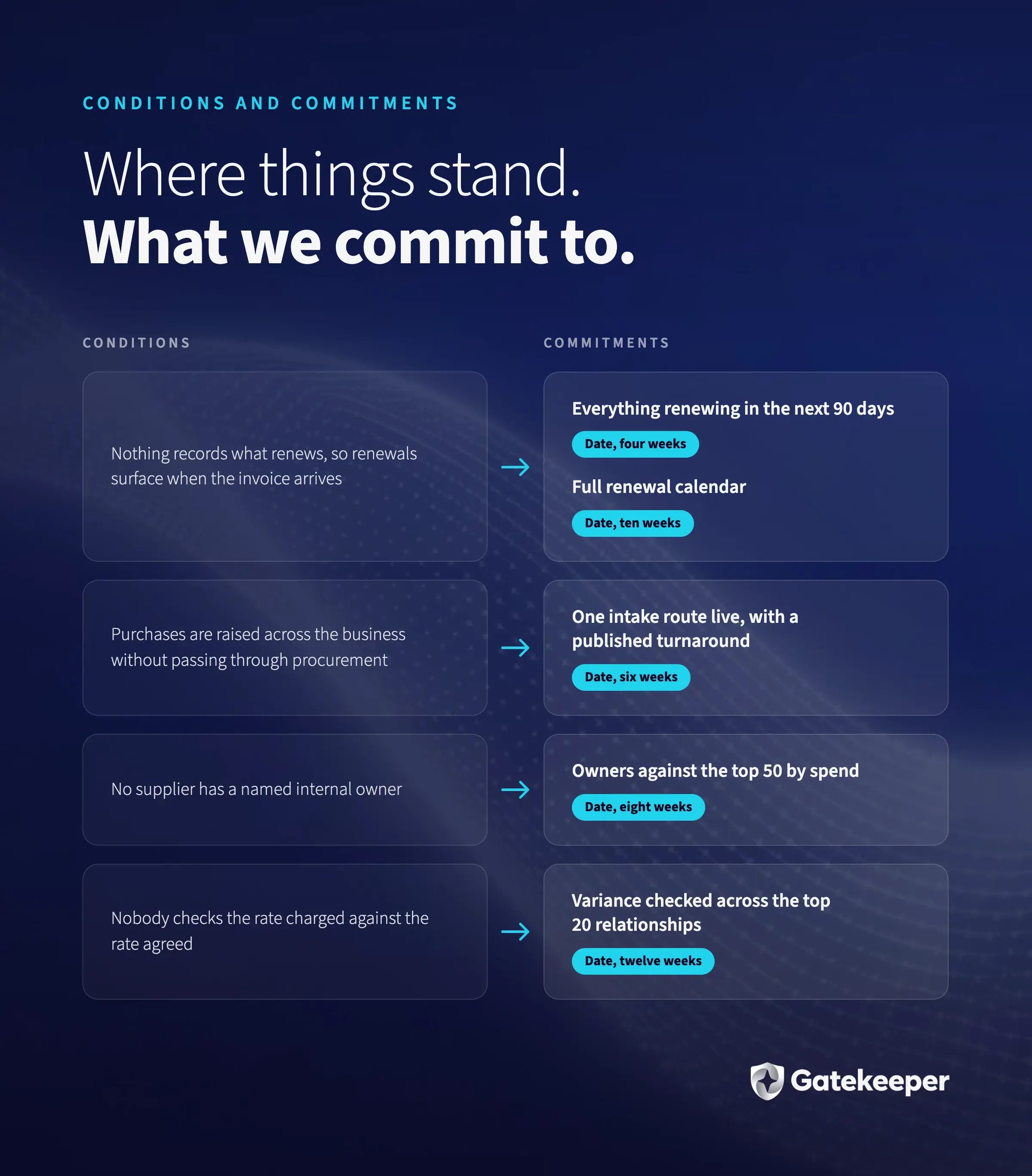
Naming your predecessor is always a mistake, even when it's accurate or fair. It invites someone to judge the person instead of the process, and the process is something the business can actively change.
Stripping out details to avoid feeling like you're blamed for them is the wrong path to take, too. You might sound like you don't have a grip on your area. Be specific about the mechanism and what you can see, but don't put blame on people past and present. Talk about notice periods that aren't tracked anywhere, so missed renewals are found out about when the invoice arrives. This is precise and useful information that can be fixed.
If you're working out the order of what to fix, we have five questions to answer that will point you to a 90-day plan to help you figure out your next steps.
Which of these have you already found?
Don't raise all three at once, otherwise, everything has equal weighting. Focus on the missed and upcoming deadlines.
A problem has already happened
An auto-renewal happened, a notice period closed, or something was committed without approval, and the deadlines attached have now passed.
There's still time to fix something
A notice window is open, with a deadline this quarter, which means you have time to review and make decisions on what to do next.
It's structural with no deadline
There's no intake route, no supplier owners, and no record of what was agreed. This goes into the plan and doesn't need to be part of the headline when speaking to your manager.
What to do next
Report it as soon as possible with options: renegotiate mid-term, exit at the next break, or absorb it and change the process to prevent it from happening again.
A missed renewal with three options attached shows someone in control.
What to do next
Raise it at the next scheduled meeting with an action already underway.
This is where getting ahead of renewals pays off. An open window leaves a decision to make, and the same window after it closes leaves you with an outcome to explain.
What to do next
Give everything realistic dates so it's formatted as a schedule of things you're doing rather than a list of items you're concerned about. Otherwise, it asks your manager to worry with you, when you've got it under control with an itemised plan of action.
What does a plan they will sign off on look like?
A plan to 'find out' is a legitimate plan of discovery and is easier to trust than one that is confident but not easily supported.
An open-ended investigation looks like a delay while you figure things out. A 90-day plan with named outputs and dates not only gives you confidence but your manager, too.
Sequence it so that the first 30 days produce work that a non-specialist can see is finished. For instance, a complete list of what renews before a stated date. A data-quality piece wouldn't be finished in such a short period, no matter how much it merits. If you need budget or headcount, as in one line at the end, proportionate to the exposure you've described.
FAQ
Commonly asked questions about talking to your manager.
Should I put it in writing or raise it in person?
Raise it with your manager in person first and confirm it in writing after. The conversation will tell you what they already know and how they want to handle it. The written follow-up records what you reported, when, and what you've proposed, which protects you if the timeline is ever reviewed.
What do I say if I'm asked why I didn't spot it sooner?
Always answer with dates rather than defence: when you started in your role, what you've looked at since, and what you've found and when. Most of this stays invisible until somebody builds the first list, so your honest answer can be that discovering it was the work, and without the list, you wouldn't have spotted it.
What if the person I report to is the reason it happened?
It's a common problem, and it changes how you might want to frame it rather than what you've found.
Drop any suggestions that something should have been done sooner. Instead, lead entirely with what the plan is and what you're doing next, and when.
Conditions stated without a date attached are hard to read as criticism and don't put the worry or blame on your predecessor or manager.
Should I raise something I have only partly looked into?
Yes, if it carried a deadline or has material exposure. Give the range, state the basis and say what you're doing to close the gap. Waiting for a complete picture means you've known for months, which is going to be harder conversation to have down the line than the imprecise one you're looking into now.
Can you point AI at data like this?
Not yet, and you'll likely be asked by your manager. According to ProcureAbuility's 2026 CPO Benchmark Study, half of senior procurement leaders name poor data quality as the leading barrier to scaling AI, which supports your point that the foundation isn't there. Those first 90 days will build on it.
ProcureAbility's 2026 CPO Benchmark study, which surveyed 160 senior procurement leaders at large enterprises, found that 50% cited poor data quality as the primary barrier to scaling AI. It sits between most procurement teams and the automation they've been promised with frontier AI models.
PROCUREMENT CONCERNS
What percent named poor quality data
as the leading barrier to scaling AI?
- 50 percent of Senior Procurement Leaders
- 50 percent of Senior Procurement Leaders
What closes the gap is dull, and the 90-day plans help produce it. One record per supplier, an owner against each, dates you can rely on, and terms pulled from the agreements that carry real money. Automation needs a reliable source to read before it can meaningfully reduce manual work. It's only as good as the data you point it at.
When the record is solid and includes notice periods and deadlines, AI agents can take on that manual work and reliably hand it back to procurement teams when a decision needs to be made.
How much can you already answer about what you've inherited?
Our five questions will point you to one of our three guidance plans that best matches your current position based on your answers.