Mid-market teams are shifting how they manage contracts and third parties.
It's not loud. It's not a single announcement. It's teams quietly moving from "keeping track of things" to "running governed processes at scale".
The numbers tell part of the story.
Across the Gatekeeper customer community this year: 1.17 million workflow cards submitted, more than double the previous year. 100,000 contracts created. 40,000 vendors onboarded. AI agents reviewing contracts and accelerating approvals. Governance frameworks are deployed across industries.
But numbers only measure activity. The more interesting shift is in what teams expect from their contract systems. Not just storage. Not just search. An operating system for how contracts and third parties actually get managed.
Here's what we built, what you accomplished, and where we think this is all heading.
2025 by the Numbers
These aren't Gatekeeper metrics. They're yours.
- 1.17 million workflow cards submitted, up from 500,000 last year. That's not just growth. That's teams moving work into governed processes instead of managing it through email and spreadsheets.
- 100,000 contracts and 40,000 vendors created across the customer community.
- 173,000+ documents signed through Gatekeeper eSign and DocuSign integration.
- 12,870 contracts extracted using Extract, a 5x increase from last year. Signed PDFs became structured, searchable records automatically.
- 135 best-practice workflows deployed, including ESG, DORA, and SIG Lite frameworks.
- 15,600 vendors had their TIN validated automatically.
- 4,014 saved views created. Teams built exactly the lens they need into their portfolios.
- 184 unique Smart Forms in use across the community, with Due Diligence, DORA, Modern Slavery, Business Resilience, and ESG leading deployment.
- These numbers represent digitisation that stuck. Processes that moved from ad hoc to repeatable. Governance that happens inside the workflow, not as an afterthought.
What We Built: The 2025 Releases
We shipped 14 major releases this year. Here's what they mean for how you work.
AI That Does the Work
Gatekeeper Agents are designed to take on repetitive, time-consuming work while keeping humans accountable for decisions that matter.
The results are showing.
CompSource Mutual deployed Gatekeeper Agents for budget validation and contract review, achieving a 95% reduction in executive review time.
That translated to 636 hours saved annually, the equivalent of 17 weeks of capacity redirected to strategic work. Finance-procurement handoffs that created rework cycles were eliminated entirely.
What shipped:
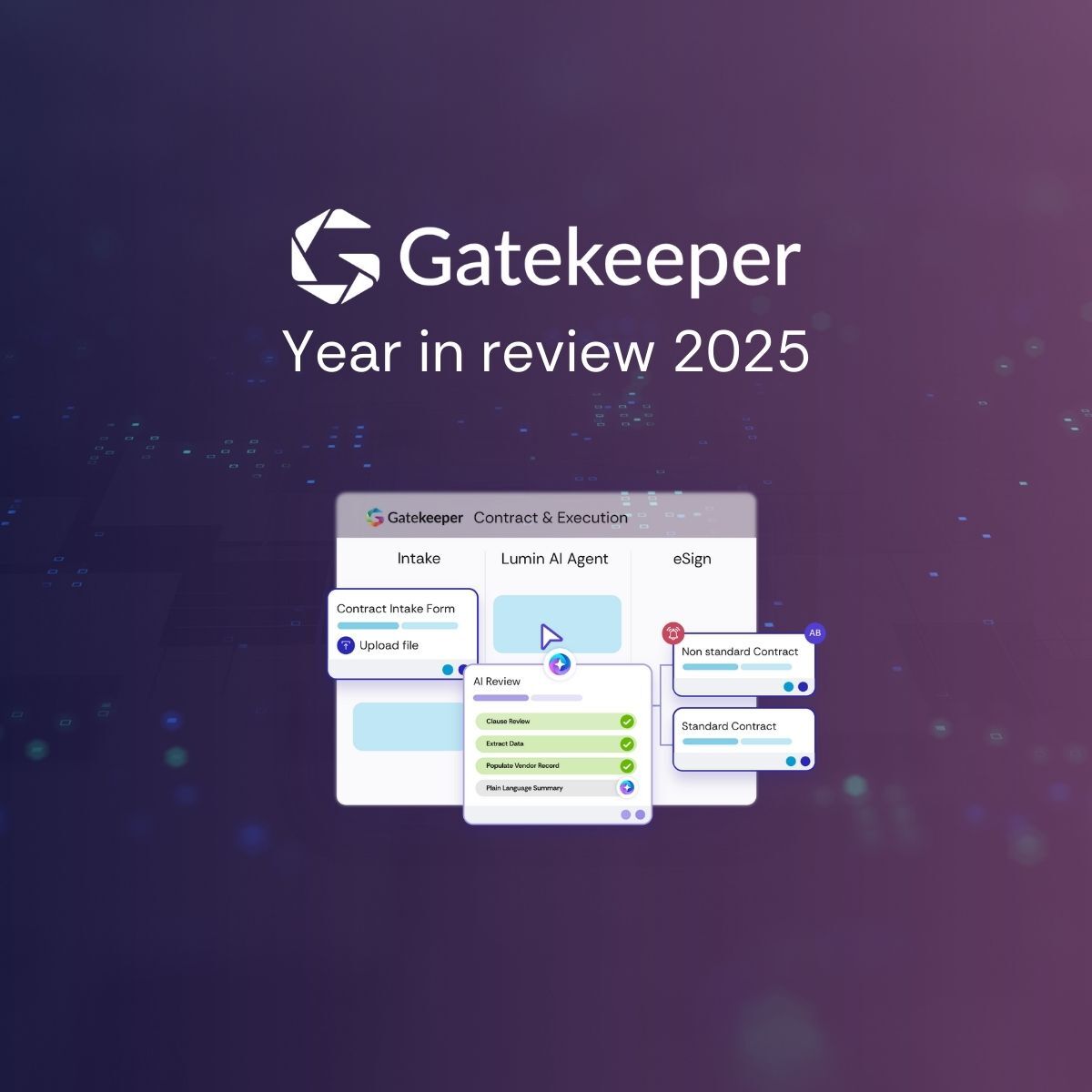
Workflow Agents that can review cards, surface findings, and now approve requests when conditions are met. The Review Agent is read-only, keeping decisions within your team. The Approve Agent can act on defined criteria, accelerating cycles without removing oversight.
Extract for any document type with custom field mapping. Email a contract into Gatekeeper and get AI extraction of parties, values, dates, clauses, personal information, contract type, category of supply, and any custom fields you need. 12,870 contracts processed this way in 2025.
Extract auto-creates full records. Upload a document and get not just extraction but a complete contract record with linked vendor or customer, ready for MarketIQ risk review instantly.
AI Insights for Obligations. Surfacing commitments, deadlines, and renewal triggers from within your contracts.
Faster Negotiation
OneDrive integration for contract negotiations, so stakeholders work where they already work. PDF-based negotiation for counterparties who won't use anything else. Default folder structures that keep versions organized from day one.
Governance That Scales
Rebuilt RBAC with clearer permissions and team roles. Sensitive data handling with proper controls. SCIM support for automated user provisioning. Pre-built workflows for ESG, DORA, and SIG Lite.
Visibility That Drives Decisions
Custom dashboards launched and immediately became one of our most-used features. 96 dashboards built with 316 widgets. More capabilities are shipping this month.
4,014 saved views created. Major API enhancements for teams extending Gatekeeper into their broader stack.
To see all of our releases, please visit our interactive Gatekeeper demos and our comprehensive Knowledge Base.
The Unified Lifecycle: Why Architecture Matters
Here's the thing about AI in contract management: it only works if there's something to connect to.
An AI that can read a PDF is useful. An AI that can read a PDF, understand which vendor it relates to, check the associated risk profile, compare terms against your playbook, surface obligations, and trigger the right workflow based on what it finds, that's something else entirely.
This is why unified contract lifecycle management matters. Not as a product category. As an architecture decision.
Most organisations feel the cost of contracting in the handoffs. Context is lost between intake and review. Evidence is chased between due diligence and approval. Renewals arriving as surprises. Obligations documented but never tracked.
Gatekeeper keeps the full lifecycle connected: intake, due diligence, drafting, review, signature, activation, governance, and renewal. Customer and vendor agreements in one place. Vendor contracts get extra depth because that's where governance requirements concentrate: screening, evidence capture, risk signals, audit trails.
When AI operates inside this architecture, it has context. It can do more than summarise. It can act.
But there's another benefit that only becomes obvious when something external changes. When your contracts live in a unified, structured repository, you can query across all of them.
When regulations shift, when legislation passes, when you need to understand your exposure or demonstrate compliance, you're not starting from scratch. You're asking questions of data that already exists in a form AI can work with.
The teams investing in structured contract management now are building the foundation for regulatory response later. That's not a theoretical benefit. It's what separates "we'll need a few weeks to pull that together" from "here's the answer".
Where We're Headed: Gatekeeper AI And Agents
Here's the use case that gets us most excited about where Gatekeeper AI is heading.
New legislation passes. A regulation changes. Sanctions are imposed. Your legal or compliance team needs to know: which contracts are affected? Which vendors are exposed? Are we compliant or not?
Traditionally, that's weeks of work. Pull reports from multiple systems. Engage legal to review documents. Manually check clauses across dozens or hundreds of contracts. Build a spreadsheet to track findings. By the time you have answers, you've burned significant capacity, and the deadline is closer than you'd like.
With Gatekeeper Agents operating across a unified contract repository, that becomes a different conversation entirely. Query your entire portfolio. Surface the contracts with relevant clauses, or without them. Identify which vendors fall under the new requirements. Understand your compliance position in minutes, not weeks.
- DORA comes into effect, and you need to identify all ICT third-party contracts with the right provisions? Ask the question, get the answer.
- New data protection requirements and you need to know which contracts have adequate clauses? Same thing.
- Tariffs change, and you need to understand supply chain exposure?
- ESG reporting obligations shift, and you need to demonstrate supplier compliance coverage? The data is there, structured and queryable.
This is what AI inside a unified lifecycle actually enables. Not just faster processing of individual contracts, but the ability to treat your entire contract portfolio as a responsive, queryable asset. Compliance becomes something you can demonstrate on demand, not something you scramble to prove when asked.
Mid-market teams are expected to do enterprise-grade work without enterprise headcount. AI is the lever that makes this possible. And the teams that have their contracts structured and connected are the ones who'll be able to respond when the landscape shifts.
That's what we're building toward with Gatekeeper Agents. An AI workforce that operates inside the contract lifecycle, with clear capabilities, defined permissions, and human oversight preserved throughout.
Here's what that looks like in practice.
Already Live
- Gatekeeper Agent with Review Capability. A read-only agent that reviews workflow card details and surfaces findings. Decisions stay with your team. The agent prepares the context so reviewers can move faster.
- Gatekeeper Agent with Approve Capability. Automated approval where the agent evaluates cards against defined criteria and approves when conditions are met. Audit trails preserved. Exceptions flagged for human review.
In Progress
- Enrich. Populating existing contracts using associated master records to create a fully enriched repository. For teams with legacy data that needs structuring.
- Workflow Agent with Update Form Capability. Allowing the agent to modify and populate workflow form fields during execution. Automating corrections and data entry while the workflow runs.
Planned
- Chat in the Vault. A conversational interface inside your contract repository. Ask questions, uncover insights, navigate data through natural language.
- Sourcing Agents. AI embedded across sourcing activities: evaluation, comparisons, documentation, workflow progression. AI-first sourcing, not AI-assisted.
- MCP. Our Model Context Platform, enabling AI models and external agents to interact with Gatekeeper data and actions through governed, permission-aware context. This is infrastructure for how AI will work with contract systems, not just Gatekeeper's AI, but any AI your organization uses.
In Discovery
- Procurement Manager Agent. An AI-driven view of contract health across your portfolio. Highlights issues, recommends optimisations, enables corrective actions. A single, central intelligence layer over your contracts.
- Third-Party Consolidation Agent. Monitors for potential duplicate suppliers and offers to merge records or create vendor hierarchy relationships. The kind of repository hygiene that never gets prioritised but always matters.
- Third-Party Evaluation Agent. Reviews the vendor record, associated contracts, supporting files, and relevant news to generate structured evaluation reports. Can execute follow-up actions when instructed.
- Gatekeeper for ChatGPT. An approved connector so users can securely chat with Gatekeeper data and trigger permitted actions directly from ChatGPT. For teams that want to work in the tools they already use.
View our full product roadmap.
Two Principles Guiding This Work
Humans remain accountable. Gatekeeper Agents reduce effort and increase consistency. Your team keeps approvals, audit trails, and decision-making. AI prepares, surfaces, and accelerates. It doesn't replace judgment.
AI delivers impact when it works inside the lifecycle. Connected to the vendor record, the contract record, the workflow, and governance controls. That's what turns AI capability into business outcomes. And that's what makes portfolio-wide questions answerable, because the data is structured, connected, and governed in one place.
The goal isn't AI that impresses. It's AI that lets you respond to regulatory changes in days instead of months, that surfaces risk before it becomes a problem, and that does the work you don't have capacity for inside the system where that work belongs.
Thank You
A genuine thank-you to every customer who pushed the platform this year.
The feedback you gave shaped what we built. The scale of what you achieved- 1.17 million workflow submissions, governance frameworks deployed, AI agents accelerating work that used to take hours- speaks for itself.
Contract management done well is invisible. Renewals that don't surprise anyone. Compliance evidence that's already there when auditors ask. Approvals that route correctly without chasing. Vendors assessed before they become problems.
That's the work you're doing. We're proud Gatekeeper is part of it.

 Integrations
Two-way data flow with the systems you already run.
Integrations
Two-way data flow with the systems you already run.
 NetSuite
Native two-way sync for vendor records, contracts and spend.
NetSuite
Native two-way sync for vendor records, contracts and spend.
 Why Gatekeeper
One platform instead of spreadsheets, inboxes and point tools.
Why Gatekeeper
One platform instead of spreadsheets, inboxes and point tools.