





Contract Lifecycle Management
Contract lifecycle management software, powered by AI.
Every contract on one unified record, with agents that review clauses, pull out obligations and chase renewals. Each one stays linked to the vendor behind it, so you see cost and compliance together.
Trusted by companies you know and love




Put the whole contract lifecycle to work.
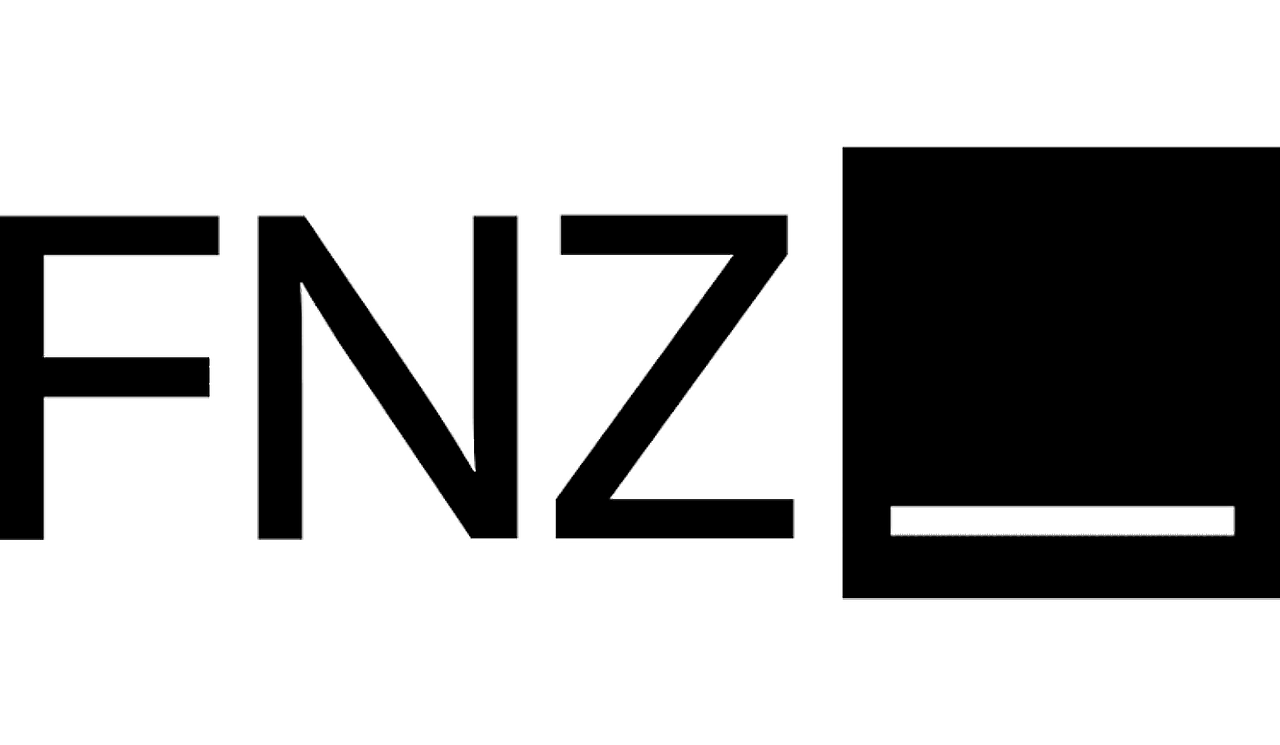
Gatekeeper runs every stage of contract lifecycle management on one unified platform and one data model, with AI agents doing the legwork so your team can focus on judgement and decision-making.
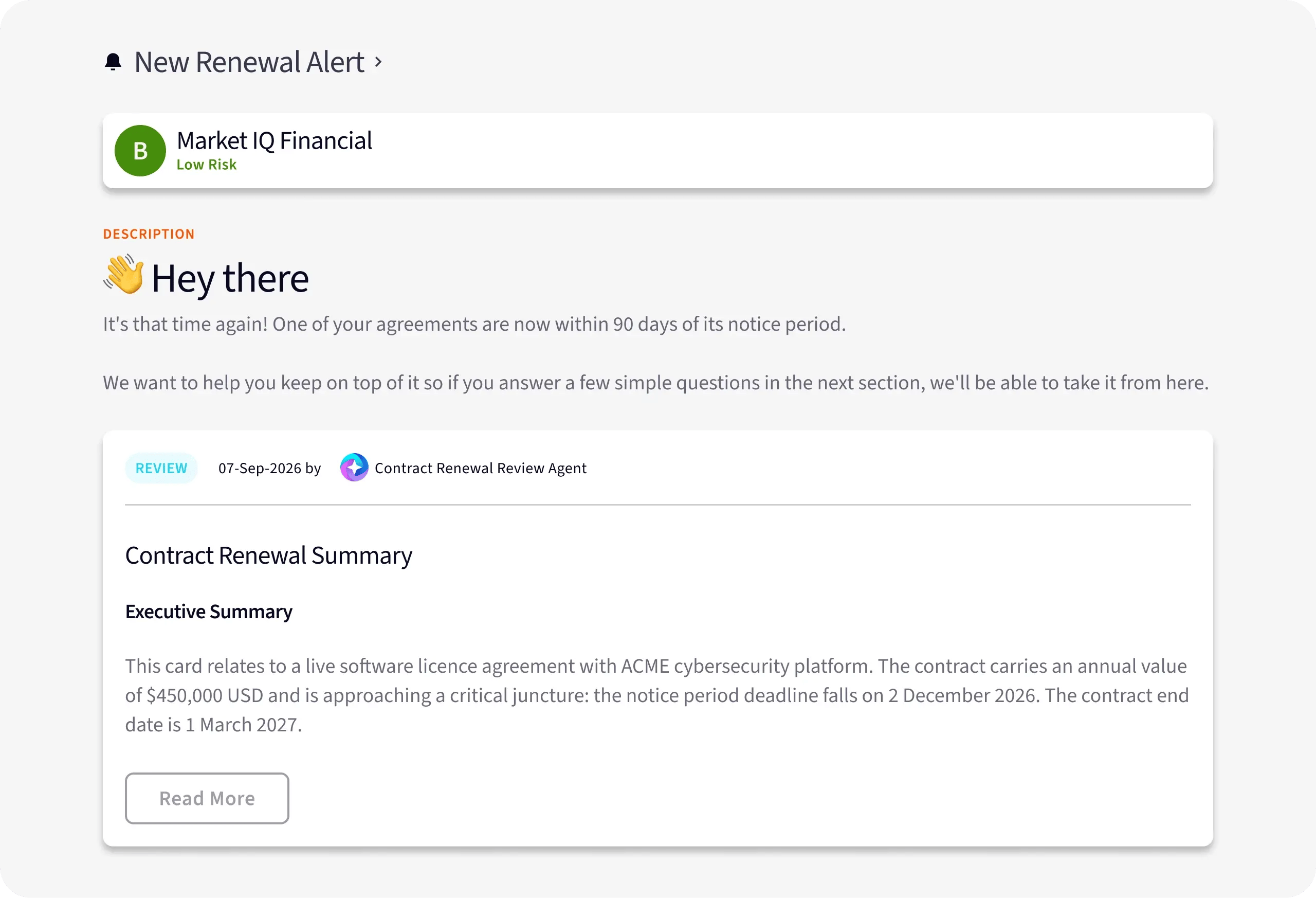
Never miss a renewal or obligation.
Contracts that auto-renew unnoticed, and obligations no one is tracking, are where budget and compliance leak. Gatekeeper tracks every renewal date and obligation, while agents monitor timelines, flag delays, and continuously measure savings.
Gatekeeper catches outdated agreements before they cost you.
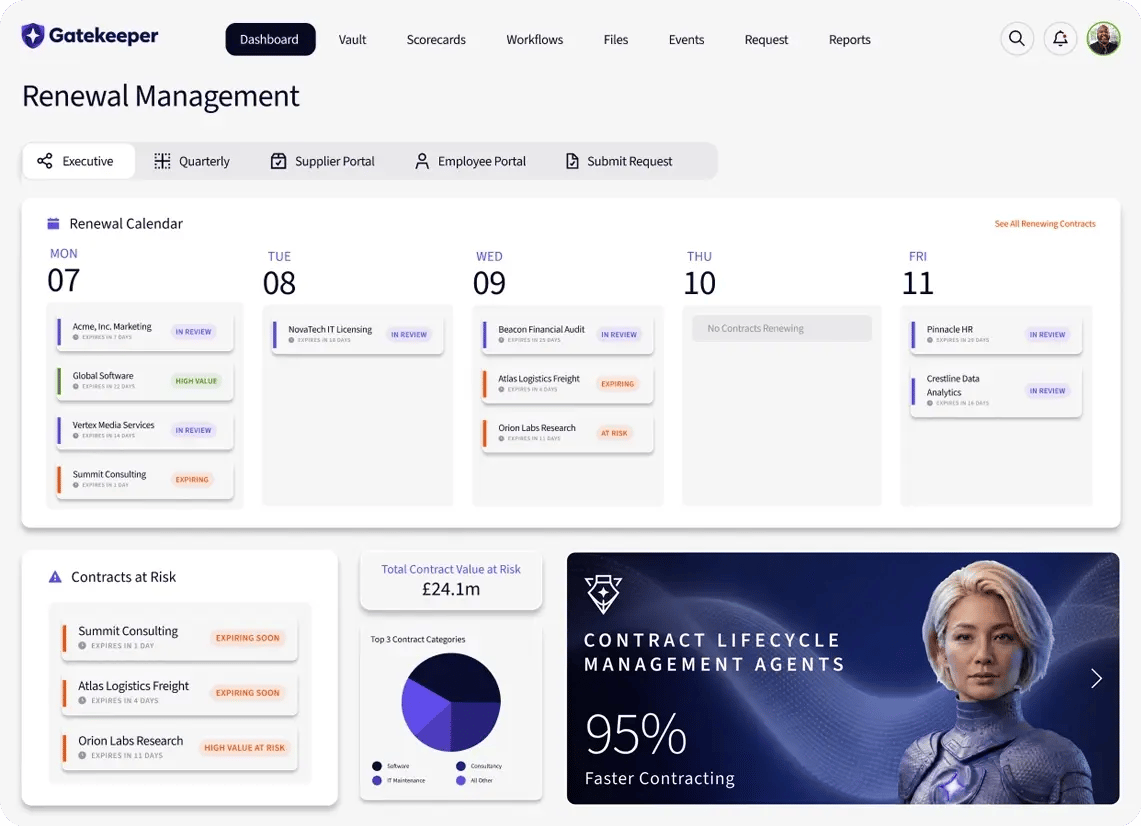
Review every contract against your playbook.
Most contract tools flag a problem and leave the work to your team. Gatekeeper Agents read each agreement, pull out the key terms, dates and obligations, and check them against your playbook.
Standard terms pass through. Deviations come to you ranked by risk, so your team only reviews what actually needs a decision.
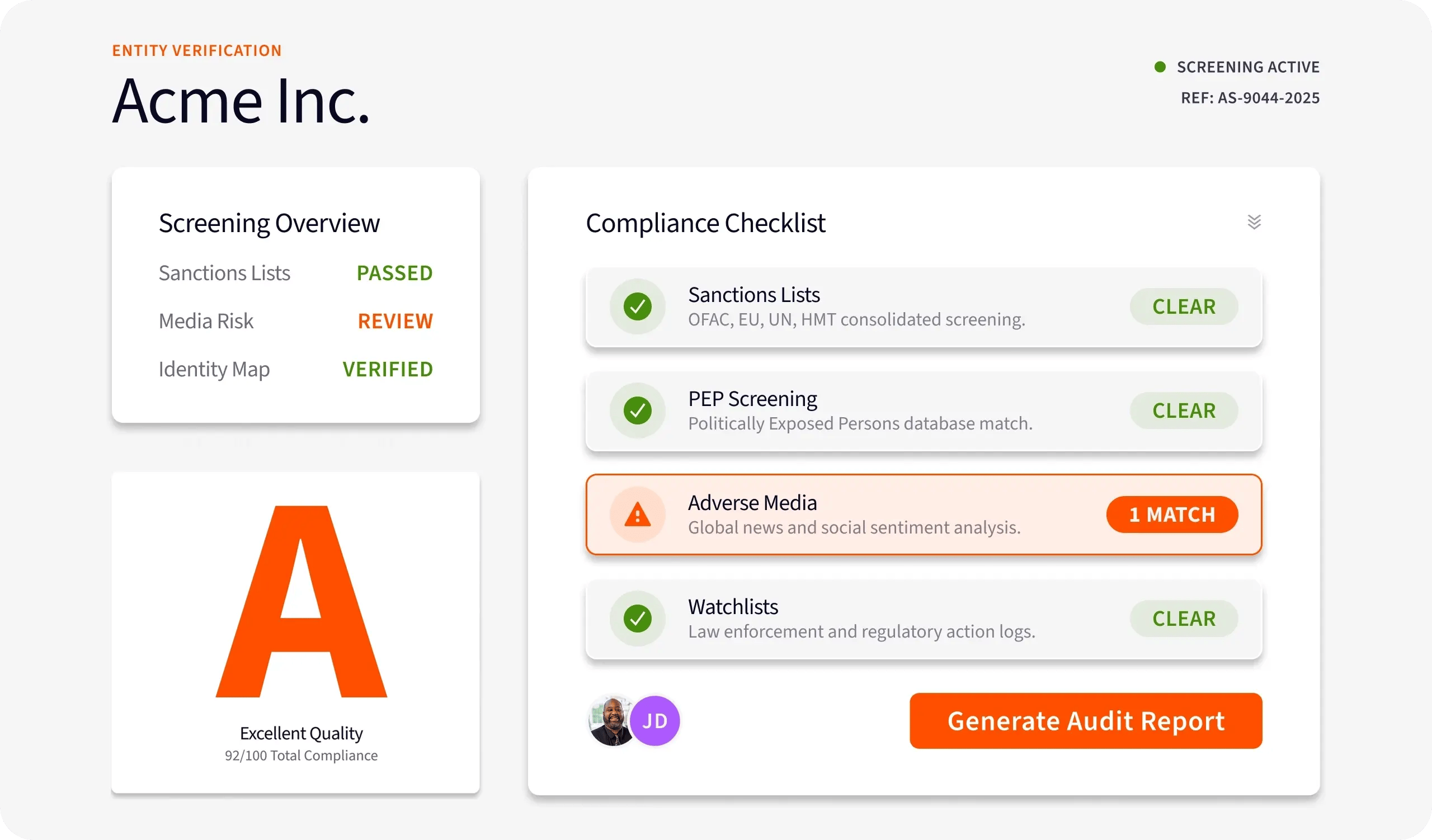
Risk is assessed from the start.
Risk usually surfaces after a contract is signed, when it is expensive to fix. Gatekeeper assesses this from the start: validating the third party, checking for duplicate records, confirming budget ownership, and assigning a risk tier so audit isn't the moment you find out.
That step stops fraudulent or duplicate vendors from getting through, prevents wasted spend, and moves only the right contracts forward.
Author faster, redline in one click.
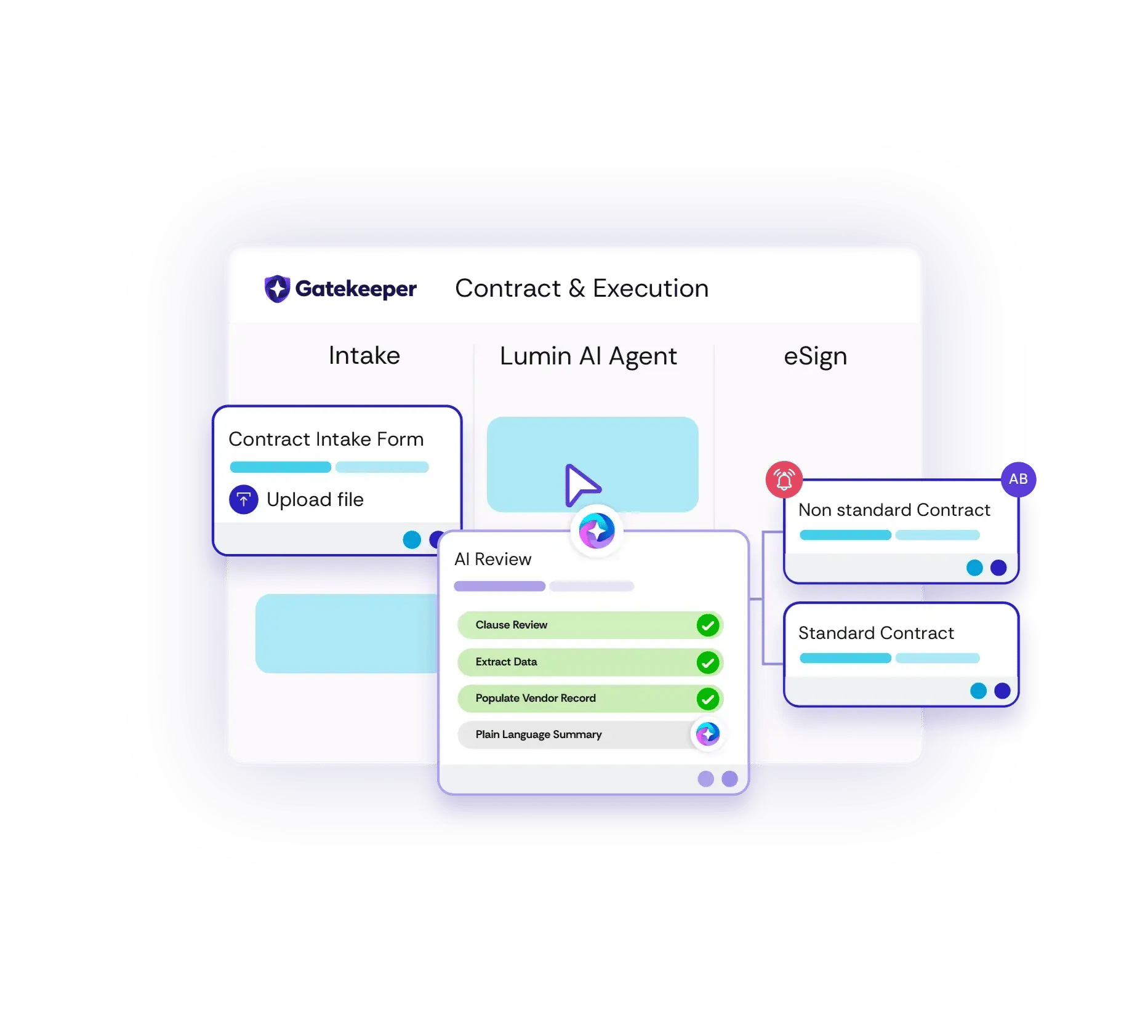
Slow, manual contract cycles stall revenue and bury teams in redlines. Gatekeeper drives every agreement from request to eSignature, with Gatekeeper AI accelerating drafting and redlining on higher-value deals.
Simple agreements like NDAs run end-to-end on their own, so none sit waiting in an inbox or get forgotten.
40
hours of contract admin saved per week
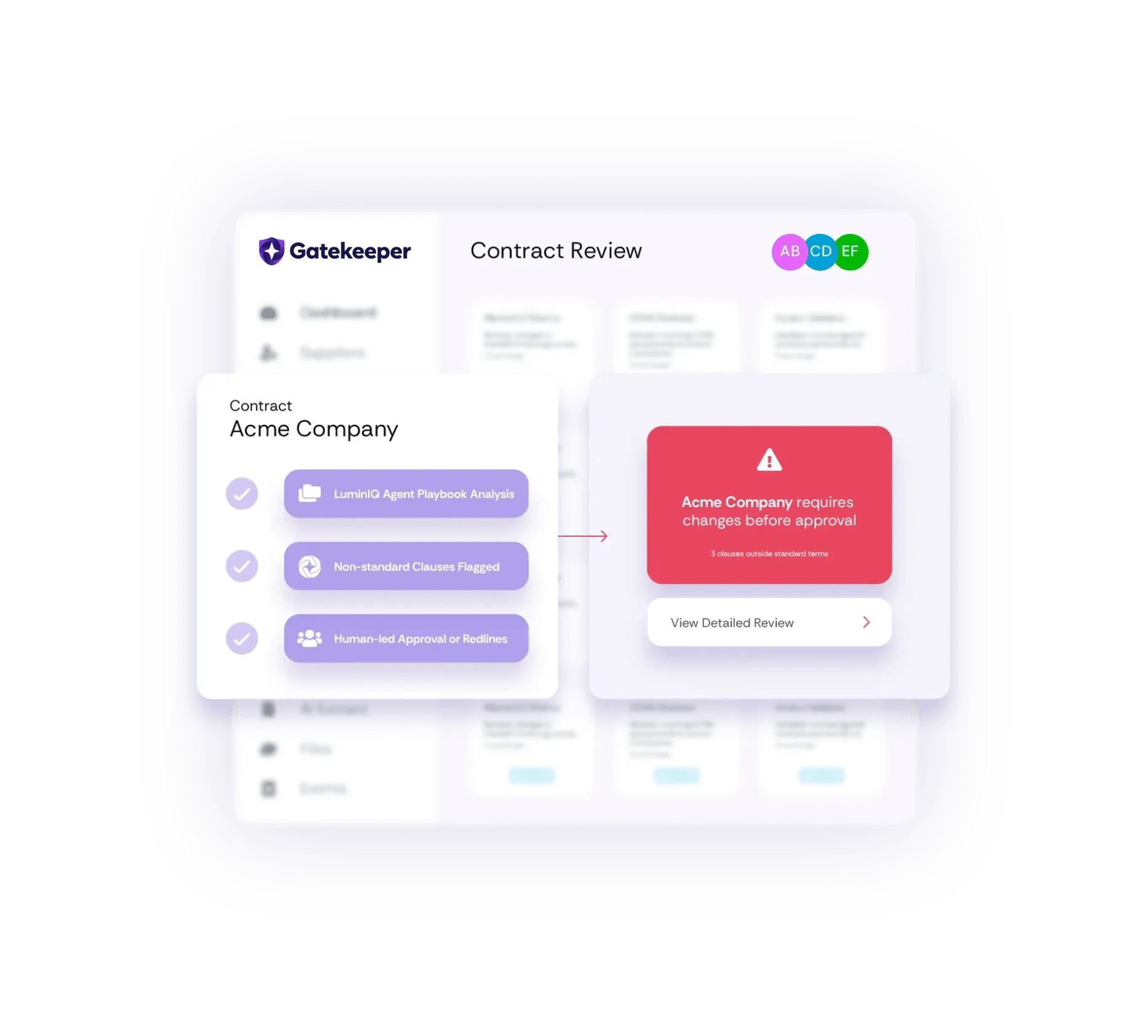
Approvals that route themselves.
Approvals stall when no one knows whose sign-off is needed. Gatekeeper routes each agreement to its dedicated team, such as Legal or Finance, based on value, category, and risk, with automatic reminders and escalations.
Your process is enforced at every step, and nothing waits on someone chasing it.
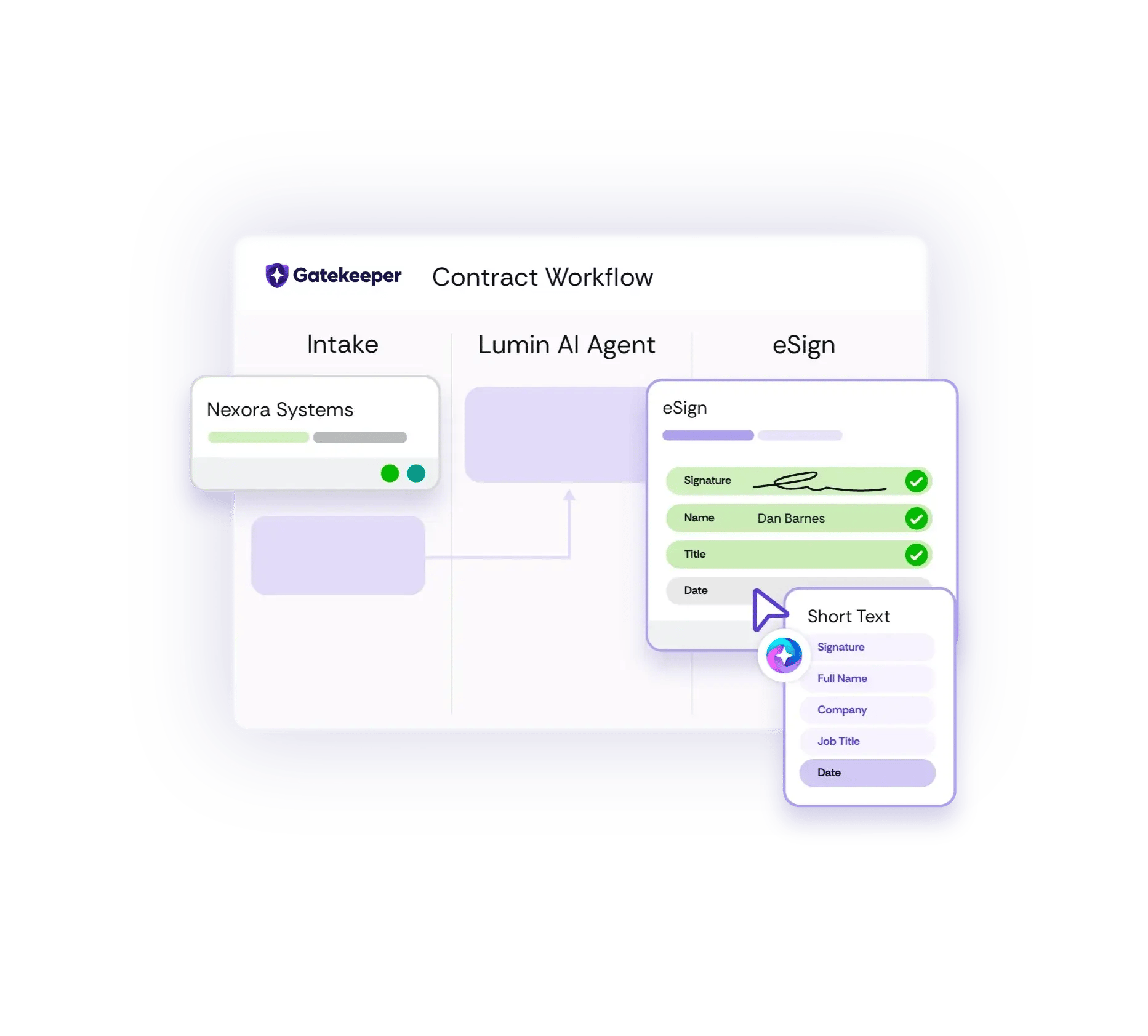
Execute with native eSign or DocuSign.
Signing should not mean losing the thread between an agreement and what it commits you to.
Gatekeeper finalises agreements with native eSign and DocuSign, locks versions, captures signatures, and links each signed record back to the obligations it creates.
Gatekeeper Interconnect™
Connect your contracts with 1,700+ applications.
Gatekeeper connects to the systems you already run your business on, so contract and vendor data flows where it needs to without manual re-keying.
Gatekeeper Interconnect adds no-code integration to ERP, finance, and identity tools including Microsoft, Workday, ServiceNow, and Sage Intacct. An open API covers everything else, so contracting stays connected to the rest of your stack instead of sitting in a silo.
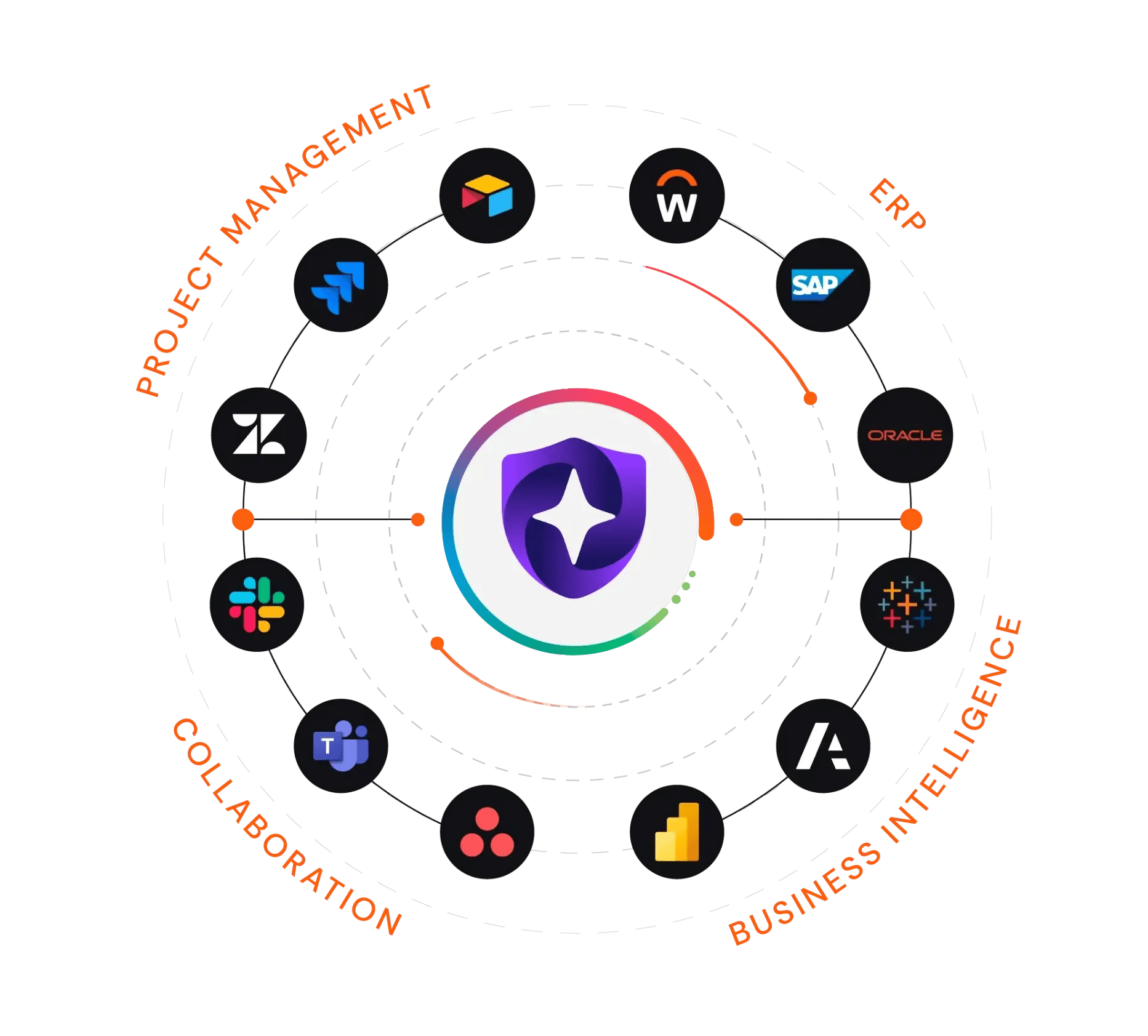
Automatically sync your contract and vendor activities with other third-party applications
.png?width=37&height=40&name=Image%20(4).png)


one unified record
Every capability, unified.

One system of truth.
Customer and vendor contracts, obligations, and renewals in one record.
See spend against contract.
Contract value sits next to what is actually being spent.
No single point of failure.
Contract knowledge lives in the platform, so nothing is lost when someone changes role or leaves.
Draft from approved templates.
Every agreement starts from language Legal already trusts.
Keep control of the clause library.
Guard-railed templates keep off-policy wording from going out.
Nothing renews unnoticed.
Every renewal date tracked, with owners and reminders set automatically.
Recognised by customers




Case studies
Real teams, real results.
-
 How Redwood Logistics automated contract renewal reviews with Gatekeeper Agents
“Gatekeeper’s Agents handle the work my team would normally do at the start of every renewal. It is 95% faster to get the context we need, on every renewal, hundreds of times a year.”
How Redwood Logistics automated contract renewal reviews with Gatekeeper Agents
“Gatekeeper’s Agents handle the work my team would normally do at the start of every renewal. It is 95% faster to get the context we need, on every renewal, hundreds of times a year.”
 Gubio Henrique
SVP of Sourcing and Purchasing, Redwood Logistics
Explore Redwood Logistics
Gubio Henrique
SVP of Sourcing and Purchasing, Redwood Logistics
Explore Redwood Logistics
-
 How CompSource Mutual reduced executive review time by 95% with Gatekeeper Agents
“Deploying Gatekeeper’s agents has been transformative for our organisation. It’s freed up so much time for us to focus on more strategic projects, and it’s really got our gears going on what we can do in the future.”
How CompSource Mutual reduced executive review time by 95% with Gatekeeper Agents
“Deploying Gatekeeper’s agents has been transformative for our organisation. It’s freed up so much time for us to focus on more strategic projects, and it’s really got our gears going on what we can do in the future.”
 Tim Harvey
Procurement Director, CompSource Mutual Insurance
Explore CompSource Mutual
Tim Harvey
Procurement Director, CompSource Mutual Insurance
Explore CompSource Mutual
-
 How Chicago Cook Workforce Partnership automated insurance certificate reviews with Gatekeeper Agents
“Gatekeeper’s Agents fit the way we already operate and run consistently against our requirements. It means the platform can grow with us.”
How Chicago Cook Workforce Partnership automated insurance certificate reviews with Gatekeeper Agents
“Gatekeeper’s Agents fit the way we already operate and run consistently against our requirements. It means the platform can grow with us.”
 Dave Swanson
Senior Project Manager, Chicago Cook Workforce Partnership
Explore Chicago Cook Workforce
Dave Swanson
Senior Project Manager, Chicago Cook Workforce Partnership
Explore Chicago Cook Workforce
One unified platform for every team
Built for finance, procurement and legal teams.
-

 For Finance
Protect margins and keep evidence ready for every audit.
- Spend visibility
- Renewal oversight
- Audit-ready evidence
-

 For Procurement
Onboard and contract fast, without cutting corners.
-
Compliant onboarding
-
Risk-aware contracts
-
Supplier performance & savings
-
-

 For Legal
Keep every contract defensible, without slowing the deal.
-
Contract review
-
Clause control
-
Faster redlines
-
Expert insight & opinion
Related guides & resources.
Explore our insights, opinions, and product information on vendor & contract lifecycle management
-
 New white paper & webinar
New research from the Hackett Group: Standalone CLM is becoming a compliance risk
The Hackett Group's new white paper makes the case for running contract management and third-party risk on one data model, where a standalone CLM cannot close that gap.
Explore the findings
New white paper & webinar
New research from the Hackett Group: Standalone CLM is becoming a compliance risk
The Hackett Group's new white paper makes the case for running contract management and third-party risk on one data model, where a standalone CLM cannot close that gap.
Explore the findings
-
 COMPETITOR REVIEW
Gatekeeper vs Juro
Gatekeeper vs Juro, with dated G2 and Capterra ratings. Choose Gatekeeper if you own vendor risk as well as contract management, or Juro for contracts alone.
Read the review
COMPETITOR REVIEW
Gatekeeper vs Juro
Gatekeeper vs Juro, with dated G2 and Capterra ratings. Choose Gatekeeper if you own vendor risk as well as contract management, or Juro for contracts alone.
Read the review
-
 AI Tools & Connectors
What is an MCP Connector, and what can AI see in your data?
An MCP connector links an AI app like Claude, ChatGPT or Gemini to your business systems, so it reads live records and takes real actions on your data.
What's an MCP connector?
AI Tools & Connectors
What is an MCP Connector, and what can AI see in your data?
An MCP connector links an AI app like Claude, ChatGPT or Gemini to your business systems, so it reads live records and takes real actions on your data.
What's an MCP connector?